1. A Scene
You pick up chopsticks for the first time, holding two thin wooden sticks, trying to lift a piece of chicken. You realize your hand must do several contradictory things: one chopstick must stay perfectly still while the other moves; the tips must align; the pressure must be neither too tight nor too loose; the angle must be correct. You try several times. The chicken slips. Your hand trembles. Finally, you lift the piece. It feels like "micro-gymnastics."
And then you watch a Chinese person pick up a single grain of rice with the same chopsticks, as effortlessly as breathing. No tension. No trembling. No visible effort at all. You think: How is this even possible? What are they doing that I am not? Is it magic? Is it some secret hand training from childhood? What am I missing?
2. A Funny Misunderstanding
Many foreigners think using chopsticks is about "dexterity" — like playing the piano, or typing on a keyboard, or juggling. Practice enough, and your fingers will learn the movement. The problem is mechanical, and the solution is repetition. But chopsticks are not about finger dexterity alone. They train a whole-body coordination system that most Westerners have never consciously used.
A European once told me: "I can play piano. My fingers are fine. I type a hundred words a minute. But when I hold chopsticks, my entire arm tenses up. My shoulder hurts. It's not my fingers — it's everything else."
He was right. The problem is not the fingers. The problem is balance — not just physical balance, but the balance between tension and relaxation, between control and letting go, between focus and ease. The piano trains your fingers to hit specific keys. Chopsticks train your entire body to work as one harmonious system.
3. The Chinese Explanation
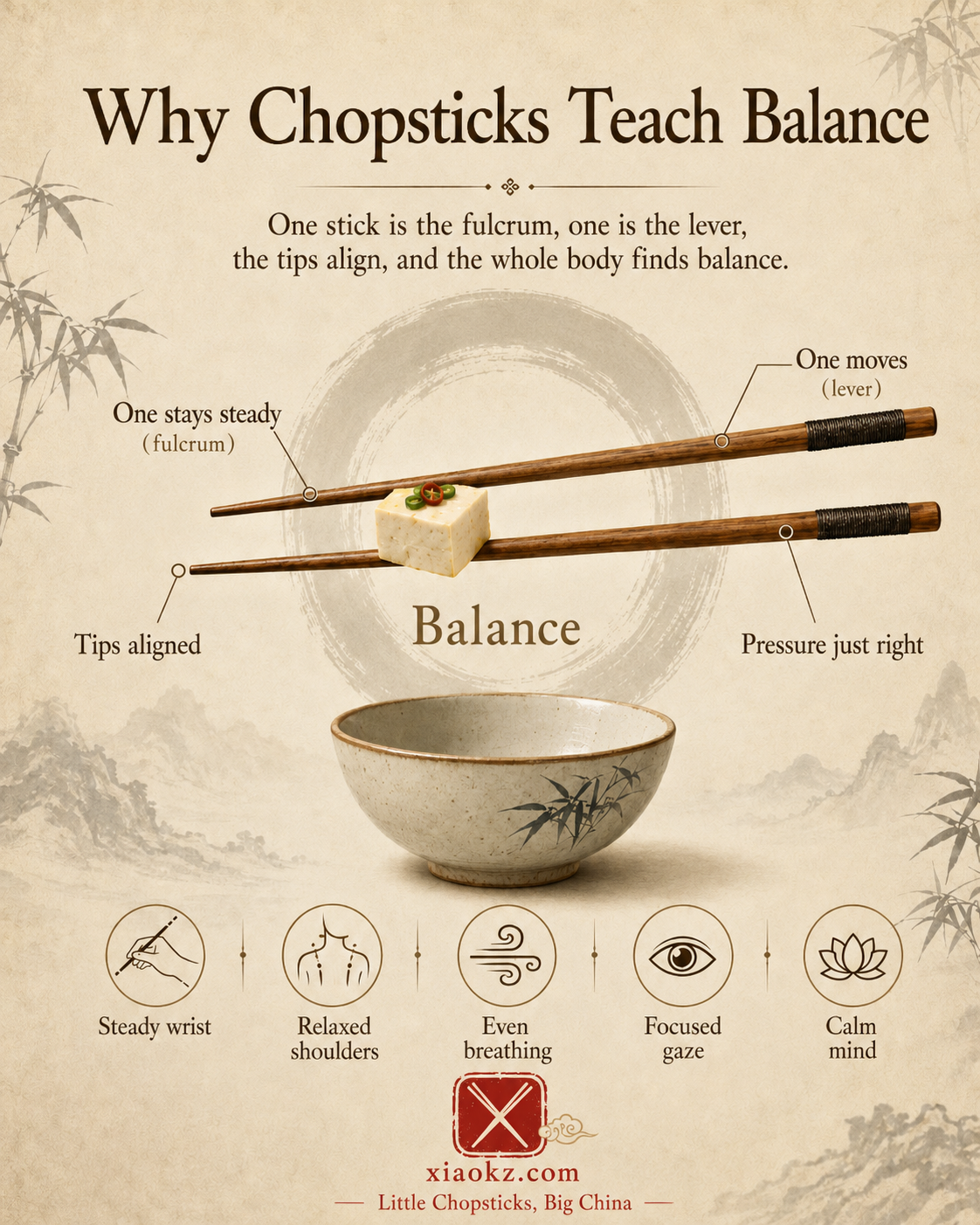
When using chopsticks, your body performs a precise balancing act: the wrist must be flexible but stable; the fingers must apply pressure but not force; the forearm must support but not dominate; the breathing must be steady; the gaze must guide; and the mental focus must be present but not anxious. It is not just "the hand moving" — it is the entire body moving in harmony, like a taiji form condensed into a few square inches.
This is why Chinese people say "using chopsticks calms the mind" — because you cannot separate your body from your mind when holding two sticks steady enough to lift a piece of silken tofu without crushing it, or a single peanut without dropping it. The body must be calm for the hand to be steady. The mind must be quiet for the grip to be right.
Chopsticks teach the whole body to work as one system. The hand does not act alone. The eye guides. The breath steadies. The chopsticks become the bridge between thought and action. They are not tools. They are teachers.
4. The Deeper Logic
Balance is one of the most central concepts in Chinese culture. Traditional Chinese medicine speaks of bodily balance between yin and yang. Taiji speaks of physical balance between yielding and firmness. Martial arts speak of force balance between attack and defense. Human relationships require balance between closeness and distance. Diet requires nutritional balance between hot and cold foods. Chopsticks are the smallest, most daily teaching tool of this "balance philosophy."
From the age of three, Chinese children practice this balance three times a day, every day, for their entire lives. They learn: one stick still, one stick moving. Too much pressure, the food breaks. Too little, the food slips. The tips too far apart, nothing is held. Too close, only a grain is picked. The balance must be just right — not by calculation, but by feeling.
This physical balance becomes a mental model. The Chinese person learns from chopsticks: in life, as in eating, all forces must be balanced — not too much, not too little, not too close, not too far, not too forceful, not too passive. The middle way is not a compromise. It is the most difficult and most elegant path. This is the Chinese way.
5. Learn a Chinese Word
平衡 (pínghéng)
- 平 (píng): flat, equal, calm, level
- 衡 (héng): measure, scale, balance, weighing instrument
- Pínghéng contains three layers of meaning: equality (公平), calmness (平静), and制衡 (check-and-balance, mutual restraint).
- When a Chinese person says "keep balance" (保持平衡), they mean not just physical stability but also the right proportion in relationships, forces, emotions, and life choices — everything must be "just right," neither excessive nor deficient.
- Remember: píng is second tone (rising), héng is second tone (rising).
6. One-Sentence Summary
> Chopsticks are the Chinese people's smallest lesson in balance. From age three, every meal is a practice in making two sticks work together just right — and that is the Chinese understanding of balance itself.