1. A Scene
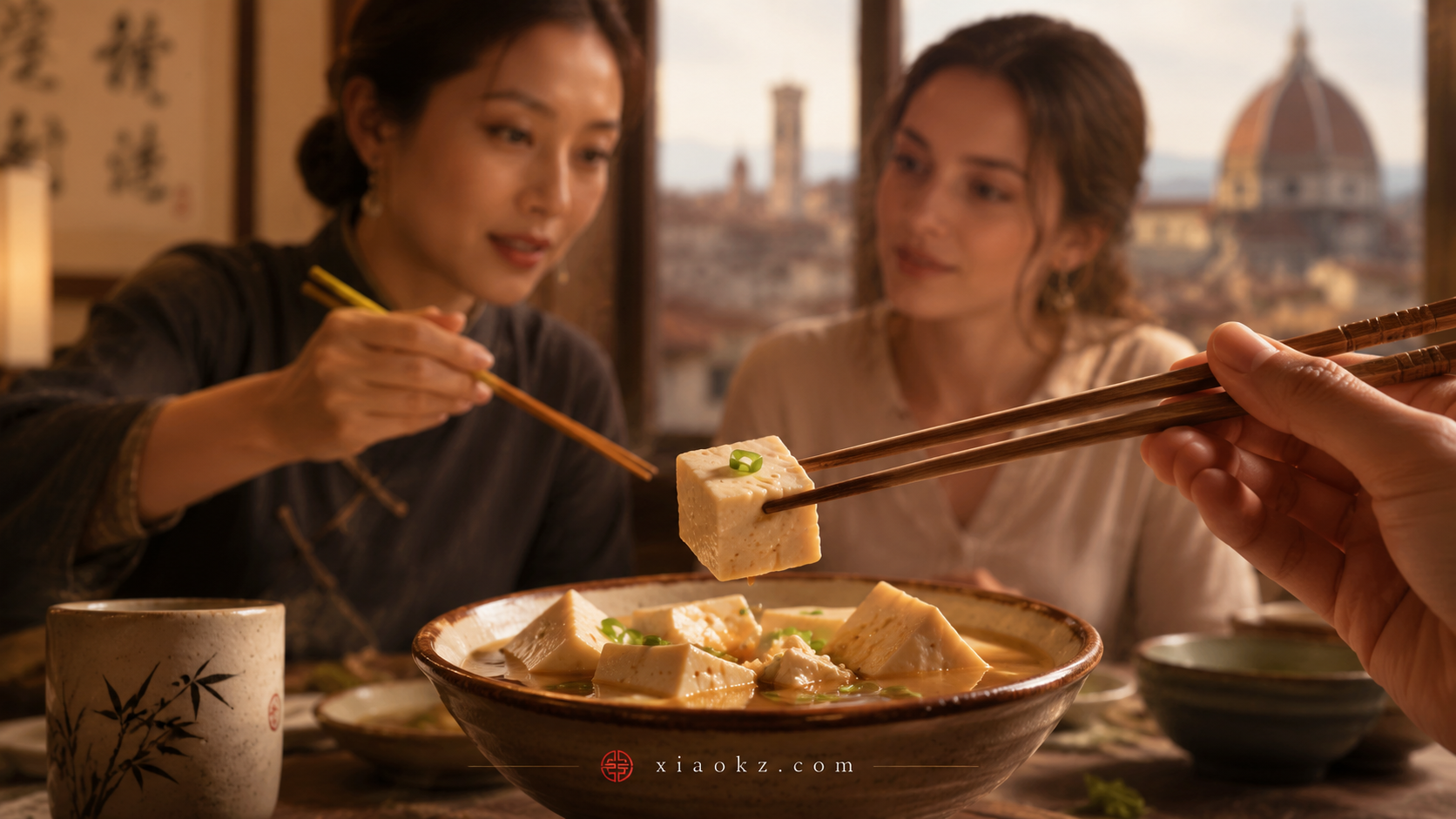
You're at a Chinese restaurant, trying to pick up a piece of tofu with chopsticks. You squeeze hard — the tofu breaks and falls on the table. You try again, gently this time — the tofu slips between the sticks and falls back into the soup. A third time, you adjust your pressure: too loose and it won't lift, too tight and it breaks again. You're frustrated to the point of annoyance, while the Chinese friend beside you effortlessly picks up a piece and places it in your bowl, smiling: "Take it slow. There is a measure to it."
"Measure?" you think. Isn't this just picking up a piece of tofu?
2. A Funny Misunderstanding
Many foreigners think using chopsticks is about "dexterity." Get good with your hands, and you'll get it. But actually, chopsticks don't test dexterity — they test a sense of fencun (分寸, the right measure).
A European once told me, after trying chopsticks for a while: "I can play the piano. Why can't I pick up a piece of tofu?" The answer is: playing the piano is about hitting the right key, but picking up tofu is about applying "just the right amount of pressure" — which is a completely different thing.
3. The Chinese Explanation
The Chinese say fencun (分寸), literally meaning "the boundary of one-tenth of an inch." But in daily life, it means "the degree of doing something just right."
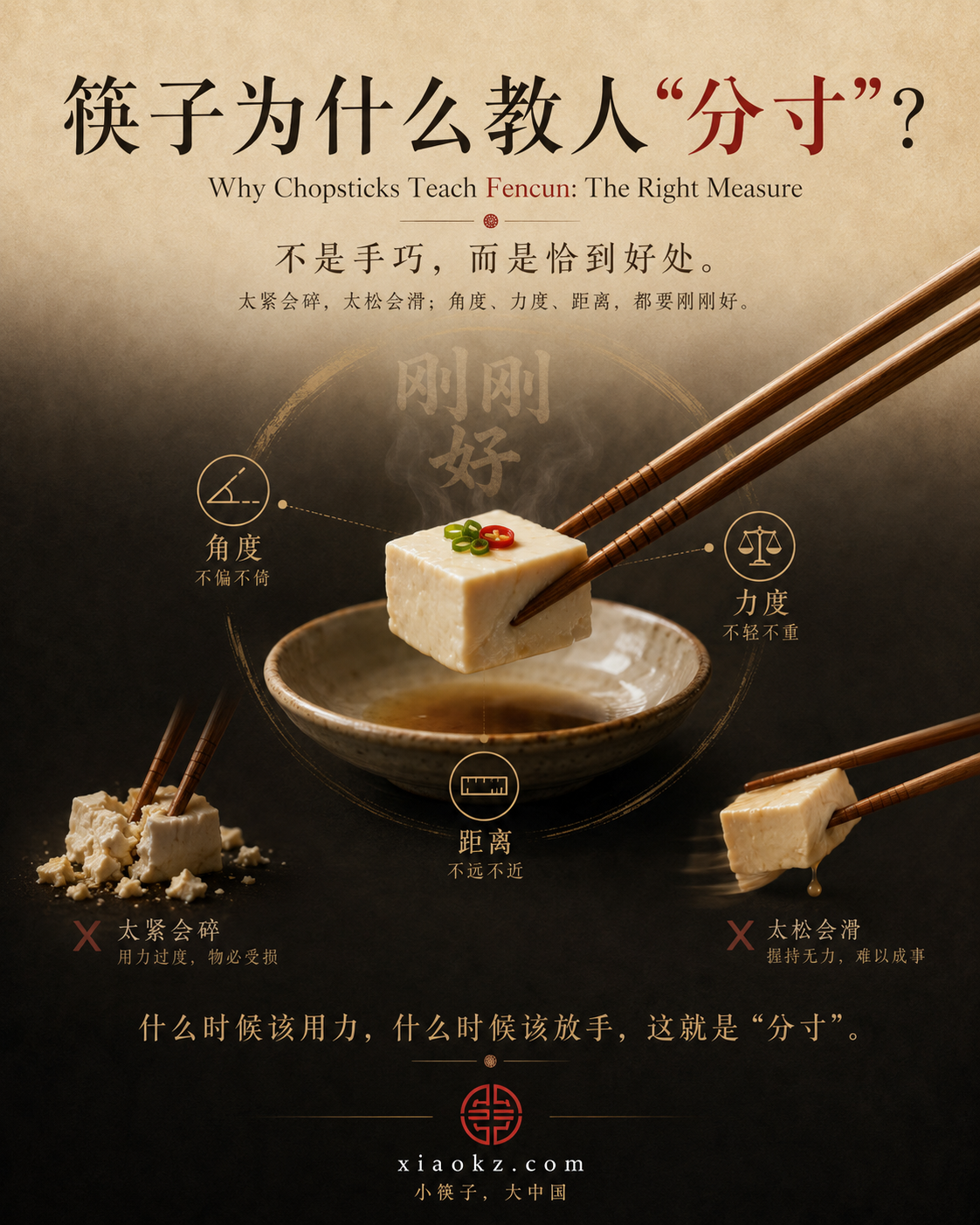
When using chopsticks, you must master:
- Angle: too vertical and you'll pierce the food, too flat and it won't lift
- Pressure: too tight and you'll crush it, too loose and it'll slip
- Distance: the tips too far apart and you can't hold it, too close and you can only pick up a tiny bit
Each of these adjustments is a practice of fencun.
4. The Deeper Logic
"Fencun" is one of the most important concepts in Chinese culture, but it has no precise English equivalent. It sits somewhere between "measure" and "tact," but it's richer than both.
The Chinese believe that the best state in the world is not "more is better," nor is it "less is better," but rather "just right." This "just right" is fencun.
- Speaking requires fencun: not too direct, not too vague
- Doing things requires fencun: not too hurried, not too slow
- Relationships require fencun: not too close, not too distant
- Picking up food requires fencun: not too forceful, not too gentle
Chopsticks are the Chinese people's fencun training device. From the age of three, learning to use chopsticks is practicing a skill that will last a lifetime: knowing when to apply force and when to let go.
5. Learn a Chinese Word
分寸 (fēncun)
- 分 (fēn): one-tenth of a cun, an extremely small unit
- 寸 (cùn): a traditional Chinese unit of length, about 3.33 cm
- Together, "fencun" refers to "the finest boundary." When a Chinese person says "this person has very good fencun," it is the highest praise — meaning they know exactly what to do in every situation, neither too much nor too little.
- Remember: fēn is first tone (flat), cun is fourth tone (falling).
6. One-Sentence Summary
> What chopsticks teach the Chinese is not just how to eat, but how to be a person: when to apply force and when to let go. That is fencun.