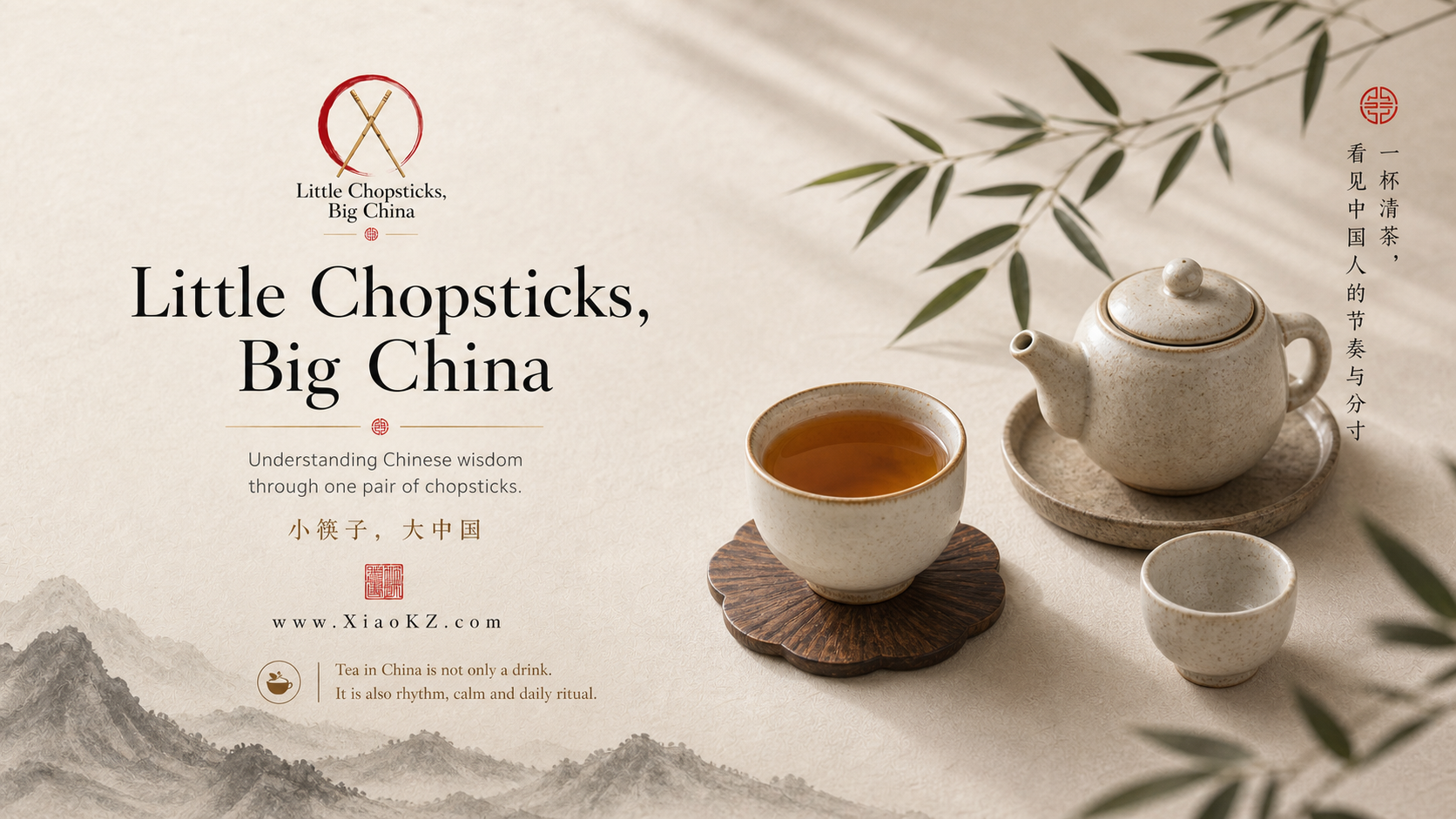
1. A Scene: Marco's "Afternoon Tea" Confusion
Last autumn, the ginkgo leaves in Florence's old town had just begun to turn yellow. In the courtyard of Giaogiao, afternoon sunlight filtered through the grape trellis, weaving dappled light and shadow onto the wooden table.
My old friend Marco came by. Marco, fifty-two, from Venice, ran a small gallery in Florence. He wore that faded linen shirt, carrying a bag in his hand — English Earl Grey tea bags, the most common supermarket brand.
"Liu," he said, placing the tea bags on the table, "I brought the 'real tea.' Shall we have afternoon tea?"
I looked at the bag of tea bags, then at his earnest expression, and couldn't help but laugh.
"Marco," I said, "do you know how Chinese people drink tea?"
"Of course," he said, "put the tea bag in the cup, pour hot water, steep for three minutes, take it out. Right?"
"That's the British way," I said, "not the Chinese way."
"What's the difference?" he asked, puzzled. "Isn't tea just tea?"
I didn't answer. I got up and went into the shop, taking out a purple clay teapot — the one I had brought back from Yixing in 2003 on my first return to China. The body had already developed a warm, lustrous patina, like a stone caressed by time.
Then I took out a small tea tray, a few small teacups, a fairness pitcher, and a tin of Tieguanyin — from Anxi, Fujian, sent by an old friend last spring.
Marco watched me lay out these utensils one by one. His expression shifted from confusion to curiosity, and then to something close to reverence.
"What is this ritual?" he asked softly.
"This is not a ritual," I said. "This is drinking tea."
---
2. A Light Misunderstanding: Tea Bags vs. The World of Tea
I put the water on to boil. The electric kettle hummed softly, like an autumn bee.
"Marco," I said, "do you know how many tea bags the world consumes every year?"
"No idea."
"A lot. But do you know — in China, almost no one drinks tea bags."
"Why?" His eyes widened. "Tea bags are so convenient!"
"Right, tea bags are convenient. But sometimes convenience is the enemy of experience."
"What do you mean?"
"The tea leaves inside tea bags are machine-cut. They're tiny enough to fit into a paper bag. But precisely because they're so small, they've lost their 'life.'"
"Tea has life?" Marco laughed. "Liu, you're speaking Chinese again."
"You'll know in a moment."
The water boiled. I didn't brew the tea right away. First, I warmed the pot — pouring hot water over the purple clay teapot inside and out. Then I put the tea leaves in — Tieguanyin leaves are curled, like little green pearls.
"Look," I said, "this is what tea leaves really look like. They're not powder, not fragments. They are whole."
I smelled the lid of the pot and handed it to Marco. He leaned in and took a deep breath.
"So fragrant," he said, "like orchids, like... like a spring meadow."
"This is called 'Wen Xiang' (smelling the aroma). Chinese people don't just pick up and drink. First, smell. Then, look. Then, sip."
I poured out the first infusion.
"Wait!" Marco exclaimed. "Why are you pouring it out? What a waste!"
"This is called 'Xi Cha' (washing the tea). The first infusion is not for drinking. It's to 'awaken' the tea leaves. Like the first minute you wake up in the morning — it's not for others to see, it's for yourself to ease into."
Marco fell silent for a moment.
"So you Chinese, when drinking tea, pour out the first infusion?"
"Yes."
"So many steps?"
"Yes."
"How long does it take to drink tea?"
"One pot of tea, if drunk slowly, can last a whole afternoon."
Marco's eyes widened.
"A whole afternoon? British afternoon tea takes only ten minutes!"
"That's the difference," I laughed. "The British drink 'afternoon tea.' The Chinese drink 'tea.'"
"Afternoon tea is a social ritual — at a fixed time, with a fixed recipe, completing a fixed task."
"But Chinese tea has no schedule. It can be a companion when one is alone, a backdrop when friends chat, a buffer during business negotiations."
"Tea in China is not an 'event.' It is a 'state.'"
---
3. The Chinese Explanation: The History and Varieties of Tea
The second infusion was poured out. Amber-colored liquid, clear and bright, like autumn sunlight captured in a cup.
"Marco," I said, "let me tell you about the history of Chinese tea."
"Legend has it that in 2737 BCE, Shennong — the agricultural deity of China — was boiling water in the wild. A gust of wind blew, and a few leaves fell into his pot. The water turned pale yellow, giving off a fragrant aroma. He tasted it and found it not only tasted good, but also made him feel refreshed."
"That is the discovery of tea."
"Of course, this is legend. But archaeological evidence proves that the Chinese were drinking tea at least three thousand years ago."
"By the Tang Dynasty, in the 8th century, a man named Lu Yu wrote a book called The Classic of Tea (Cha Jing). This is the world's first monograph on tea."
"Lu Yu wrote in the book: 'Tea is the fine tree of the South.' He said tea is a 'fine tree' — a beautiful tree. Please note, he said 'tree,' not 'grass.' Because in the eyes of the Chinese, tea is not an ordinary plant. It has character."
Marco took a sip of tea, savoring it carefully.
"This is completely different from British tea," he said. "British tea is bitter. You need milk and sugar to drink it. But this... this has sweetness, floral notes, and something... I can't quite describe."
"This is called 'Hui Gan' (returning sweetness). Good Chinese tea may taste slightly bitter when it enters the mouth, but after swallowing, a sweetness rises from the throat. This is not added sugar. It is the taste of the tea leaf itself."
"Chinese tea is divided into six major categories:"
"Green tea — unfermented, preserving the freshest original flavor of the tea leaf. West Lake Longjing, Biluochun — these are green teas."
"White tea — lightly fermented, white like silver needles, with a delicate flavor. Favored most by people from Fujian."
"Yellow tea — one more step of 'men huang' (sealed yellowing) than green tea. Very rare and precious."
"Qing tea — also known as oolong tea, semi-fermented. Tieguanyin, Da Hong Pao — these belong to this category. The one you're drinking is Tieguanyin."
"Red tea — fully fermented. What the British call 'black tea' is what the Chinese call 'red tea' (Hong Cha). But please note, when Chinese people say 'red tea,' they mean fermented tea; when the British say 'black tea,' they mean the same thing."
"Dark tea — post-fermented. Pu'er tea is the most typical. The older, the more fragrant. Can be stored for decades."
"So," I looked at Marco, "when the British say 'tea,' they usually mean black tea with milk. But when the Chinese say 'tea' (Cha), it could be six completely different things."
"And even the same tea, brewed by different people, tastes different."
"Why?" Marco asked.
"Because brewing tea is not just technique. It is 'Xin Fa' (the method of the heart). Water temperature, timing, utensils, even the mood of the brewer — all affect the flavor of the tea."
"The same tea leaf, in the hands of an angry person, brews astringent. In the hands of a calm person, brews sweet."
Marco looked at me, as if confirming whether I was joking.
"Are you serious?"
"I'm serious. This is the core of Chinese tea culture: tea is not just a beverage. It is a connection between man and nature, man and himself, and man and man."
---
4. The Deeper Logic: Tea and Coffee, Two Concepts of Time
The third infusion. The Tieguanyin leaves had fully unfurled, like little green fish swimming at the bottom of the pot.
"Marco," I said, "you've lived in Italy so long, you must understand coffee."
"Of course," he puffed up his chest, "Espresso is the soul of Italy."
"Then tell me, how do Italians drink coffee?"
"Stand at the bar, drink it in one gulp, then leave."
"Right. A cup of Espresso, from ordering to finishing, takes no more than two minutes."
"But in a Chinese teahouse, one pot of tea can last a whole afternoon."
"Do you know why?"
Marco thought for a moment: "Because Chinese people have a lot of free time?"
I laughed.
"No. Because the Chinese understanding of 'time' is different."
"In 1998, I first went to Germany. I noticed the way Germans drink coffee — in Germany, coffee is 'functional.' Drink a cup in the morning to wake up; drink a cup in the afternoon to rest. Coffee is fuel, a tool."
"Later, when I arrived in Italy, I found Italians drink coffee with more sophistication — but even with sophistication, it's 'fast sophistication.' Stand at the bar, chat a couple of sentences with the barista, drink in one gulp, leave."
"But the way Chinese people drink tea..."
I paused, recalling many memories.
"In 2005, I was in an old teahouse in Fuzhou. An old man invited me to drink tea. We drank for three hours. In those three hours, we talked about his grandson, my restaurant, stories from the past, worries about the future."
"The tea was finished, but our words were not."
"The old man said: 'Drinking tea is not for quenching thirst. It is to leave a blank space for yourself.'"
"I have remembered that sentence for twenty years."
"Marco, have you noticed: Europeans drink coffee to 'continue' — to continue working, to continue talking, to continue living."
"But Chinese people drink tea to 'stop' — to stop, to let time slow down, to make oneself 'present.'"
"Coffee is acceleration. Tea is deceleration."
"Coffee is 'I want to do more.' Tea is 'I want to feel what is happening right now.'"
"So Chinese tea is not a beverage. It is a 'way of being' — a way to slow down, to quiet down, to return to the present moment."
Marco set down his teacup and was silent for a long time.
"Liu," he finally said, "I think I understand. The British drink afternoon tea to complete a social task; Italians drink coffee to fuel themselves; but Chinese people drink tea..."
"To do nothing."
"Right." I nodded. "To do something for the sake of 'doing nothing.'"
"This is hard to understand in Western culture. Westerners say 'time is money.' Time is money. But the Chinese say 'Cha Yao Man Pin' — tea must be savored slowly. Only when it's slow does it have flavor."
"This is not a question of efficiency. It's a question of the quality of being."
---
5. Learn a Chinese Word: Why Is It Called "Cha" (Tea)?
The fourth infusion. The color of the tea soup had begun to lighten, but the aroma remained subtle and fragrant.
"Marco," I said, "let's learn a Chinese word today."
I wrote one character on paper: 茶.
"Look at this character. On top is '艹' — the grass radical, indicating a plant. Below is '人' (person) and '木' (tree)."
"Why?"
"Before the Tang Dynasty, tea was not written as '茶.' It was written as '荼' — a grass radical on top, and '余' below. 'Tu' in ancient times had many meanings. Sometimes it referred to bitter vegetables, sometimes to tea."
"By the Tang Dynasty, when Lu Yu wrote The Classic of Tea, he removed one horizontal stroke from '荼,' turning it into '茶.'"
"Why remove one stroke?"
"Because Lu Yu believed tea was special. It should not be mixed with 'bitter vegetables.' Tea has its own character."
"Look at the structure of '茶': grass, person, tree. A plant (grass), a person, a tree (wood)."
"This hints at the essence of tea: it is a bridge between man and nature. A person stands between grass and wood, connecting with nature through a cup of tea."
"So the character '茶' itself contains the Chinese understanding of tea — not a processed product, not a commodity, but a relationship between man and nature."
Marco picked up the paper and looked at the character carefully.
"So beautiful," he said. "Much more beautiful than the English word 'tea.' 'Tea' is just a sound, with no meaning at all. But this character... it's a painting."
"Right." I said, "And have you noticed: the pronunciation of '茶' is almost the same in different languages. Chinese reads 'cha,' Japanese reads 'cha,' Korean reads 'cha,' Russian reads 'чай' (chai), Arabic reads 'شاي' (shay), Portuguese reads 'chá'..."
"Why?"
"Because China was the earliest country in the world to export tea. The word '茶' traveled along the tea trade routes, spreading all over the world."
"But interestingly, the English word 'tea' does not come from 'cha,' but from the Minnan (Southern Fujian) dialect 'tê.' Because the earliest British tea merchants bought tea from the port of Xiamen in Fujian, where people speak the Minnan dialect and call tea 'tê.'"
"So the English 'tea' and the Chinese '茶' are actually two dialect pronunciations of the same word."
Marco laughed: "So for three hundred years, every time we've been drinking tea, we've been saying a Chinese dialect word."
"Yes." I laughed too. "So every time you say 'tea,' you are saying a Chinese word."
---
6. One-Sentence Summary: What Took Me 25 Years to Understand
The fifth infusion. The tea soup had become very light, almost transparent, but there was still a faint orchid fragrance.
"Marco," I said, "do you know how long we've been drinking this pot of Tieguanyin?"
He looked at his phone, surprised: "Two hours?"
"Right. Two hours. We drank five infusions, and talked a whole afternoon."
"In Britain, in the same two hours, you might have already drunk ten cups of tea bag tea. In Italy, you might have already drunk sixty cups of Espresso."
"But we only drank five infusions. And each infusion tasted different."
"The first infusion was awakening. The second was blooming. The third was the peak. The fourth was aftertaste. The fifth was farewell."
"A single tea leaf, just like that, completed its life journey."
Marco looked at me. There was something new in his eyes — not confusion, not curiosity, but a kind of understanding.
"Liu," he said, "I think I understand why, after twenty-five years in Florence, you still speak like a Chinese person."
"Why?"
"Because some understandings don't come from books, but from... from a cup of tea like this."
I smiled. The sunlight had already moved to the other side of the courtyard. The shadow of the grape trellis had grown longer. In the distance, the bells of an old church in Florence's old town rang out.
> Tea is not a beverage. It is a way the Chinese use to be present.
>
> It took me 25 years to understand: when I pick up the teapot and pour a cup of tea, I am not quenching my thirst. I am pressing the pause button on time — letting tea teach me what slow is, what quiet is, what it means to live in the present moment.
---
Have you ever tried spending an entire afternoon drinking just one pot of tea? Or do you think tea is just tea bags and hot water? Tell me your thoughts — xiaokz's next article might be written for you.